


Minority-Owned Businesses Create Change Beyond Financial Success
According to the Pew Research Center’s 2023 data, the number of minority-owned businesses has grown significantly in recent years but still only makes up about 3.4% of all U.S. businesses. In Pennsylvania, the percentage is even lower than the national average, with only between 1.1% and 3% of businesses being minority-owned.
In Pittsburgh, the landscape varies, but we spoke with several successful entrepreneurs, all of whom seem to have a similarly minded goal: to make their communities a better and brighter place through their products and business models.

Body By Design
Having grown up with health as a core value, helping to take care of her mother who struggled with chronic pain and scoliosis, perhaps it was destiny that Heather Brown gravitated toward a career in wellness. She started a massage business in 2008 as a solo practitioner, not predicting that her business would grow exponentially. After 800 people bought her Groupon in 2010, she realized that she needed to bring on employees. Today, she is the owner of Body by Design, a McCandless-based holistic wellness spa, with a team of eight licensed massage therapists.
“I’m really just dedicated to helping people achieve optimal wellness,” she said.
Brown worked toward her goal by building valuable relationships, networking, and having integrity. “That is why I am where I am, just being able to be genuine and show up authentically,” she said. “I think a lot of people have a financial plan when they come into business. For me, I just wanted to take care of people; figuring out the business aspect of things came later for me. It was about how can I serve others and help them feel their best; that is where my heart is,” she said.
Brown believes that Body By Design stands out from some other spas because her business is not standardized. “Every massage is personalized and tailored, and that starts from the moment you walk in the door.”
To Brown, success is living life on your own terms, having the freedom to do what you love, and making an impact. “I tell people: you only get one body, and investing in your health is critical.”
Future plans include bringing massage into the workplace by helping employers understand the benefit of how massage can improve work-life balance. “I definitely see us doing more with the mental health space. There is so much that happens in the body that is tied directly to trauma, and it’s impossible to ignore that.”

Lipstyck Lab
All Jae’ Wiley ever wanted to do was bring a little beauty into the world. As a hair and cosmetics professional for more than 25 years, Jae’ came up with the idea for a custom lipstick bar. “You can get your nails and hair done, but where can you create our own custom cosmetics?” she said.
After attending the Pittsburgh Black Market, a pop-up market highlighting Black-owned businesses, Jae’ received a lot of good feedback about her concept and decided to go for it. “I always wanted to run my own business, but I didn’t want to open up something that was already here,” she said.
Today, Jae’ is the proprietor of the city’s first make-your-own-lipstick business, called Lipstyck Lab. Headquartered in Squirrel Hill, customers can come in and, using all plant-based ingredients, mix their perfect shade of lipstick or gloss. “When you come into the lab, it’s like a class setting. You do not have to have a group; you can come with one or two people, though the maximum is 8-10. I want them to come in and have the time of their lives,” she said. With ’90s music playing in the background and people allowed to bring in drinks, she turns lipstick creation into a fun and engaging activity. Jae’ helps women find what works best for them, and because she views everyone who walks out of Lipstyck Lab as her ‘walking billboard,’ she makes sure customers leave with just the right color.

Today, she is as busy as ever, hosting bachelorette parties, children’s parties, date nights, and customers from every demographic. She even has a mobile lipstyck lab, traveling to events. Jae’ is also in the process of developing a STEM program for girls to get the message out that there is beauty in science. Eventually, she would like to bring on employees and open other locations. “Right now, I feel like I’m a success, because I bet on myself,” she said.
Serenity Bloom
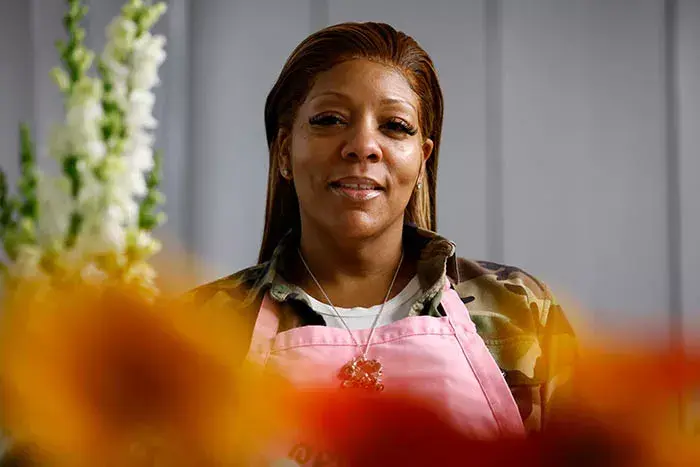
Brandi Taylor has always loved flowers, arranging them for friends and family. After years of working in health consulting, her passion for flowers evolved into a business when she opened Serenity Bloom in 2021. Located on the North Side, Serenity Bloom is one of the few minority-owned floral businesses in Pittsburgh.
It is obvious that Taylor is not your typical florist, in part because she does not offer ready-made bouquets; they are made to order. She considers her work to be ‘floral couture.’ “I don’t do a lot of vases; I do what are called hatboxes,” she said. She also hosts workshops where customers can learn how to craft their own floral works of art in her shop. Another component of her business is the Bloom Bar, where customers can rent the use of her mobile flower cart for events, with or without a ‘bloomtender.’
Taylor is honing some future plans for the business, including working with the city’s Learn and Earn Summer Youth Employment Program to train youth in the art of floral design. “I’m hoping that Catapult will support the idea I have, a few years from now, where we can start a flower garden, teaching kids how to grow flowers.”
“Being an entrepreneur allows me to show my children how to work, how to do a job for themselves and not be paid by the hour,” Taylor added. “And being Black and a woman and a single parent shows them how I’ve transitioned. They’ve seen me both in corporate America and in the nonprofit industry, the dynamics of having the ability to have multiple streams of income, and how being able to manage my own schedule takes a level of maturity and knowledge. It is important for my children to see that in me.”

Michael’s Manna
You may have bought one of his spices at a farmers market or perhaps he cooked you a gourmet meal when he was working at Nemacolin or other area restaurants. Today, Chef Michael Pattillo is the face behind Michael’s Manna, a multifaceted food service company providing catering, private chef services, and taste-bud-awakening homemade seasonings through his MaestroChef’s Products™ label. In fact, out of 1,800 total vendor applications, he was chosen as a private chef for NFL Commissioner Roger Goodell when the NFL Draft came to town.
“From starting my company to getting to this pinnacle moment is mind-blowing,” said Pattillo.
But it wasn’t without hard work, drive, ambition, and a vision. A graduate of the Le Cordon Bleu Institute of the Culinary Arts, Pattillo worked for 20 years as a classically trained chef but realized that the demanding career was taking him away from spending time with his kids. “I had to get a change of life. Being in the kitchen from 5 a.m. to 11 p.m. didn’t work for me,” he said. After a stint in life insurance sales — making good money but hating it — his sister encouraged him to get back into the food industry. But this time, he did it differently and on his own terms, working on his branding and connecting with a community of other small-business entrepreneurs. He also is the chef for the Pittsburgh Project, an inner-city after-school program.
Currently, about two-thirds of his business is comprised of catering, with his favorite dishes to make “...anything with a process. I like things that challenge me and make me think.” If he has his way, his sole income exclusively will be from his spice blends, which include Black Garlic Salt, Shallot Salt, Grill Dust, and SoulFry. Right now, his spices are in 20 stores and sold online.
But no matter what he does, his ‘why’ is his children. “I’m leaving a legacy, whether that be a big check or a business, but teaching them what it looks like to be an entrepreneur, whatever that looks like; that is the motivator.”


What sets the curated indie picks apart is the pairing of each app with the monetization choices its maker faced.
The value of a profile link often gets overlooked until you try to measure where your traffic comes from. This article explains the concept behind that single URL and why it matters for audience growth. Reading through BioLinku's take on link usage can help you think about placement and purpose more deliberately.
People who follow our blog will find regular articles covering useful and varied subjects. This post introduced several points that deserve attention. The author presented them in an organized and accessible manner. I appreciated the realistic discussion of possible challenges. The final paragraph gave the article a strong conclusion. I will return for more.
Congratulations to the Fox Chapel Area High School Marching Band on an amazing win! “Cosmos” sounds like a powerful show, and the recognition for Visual and General Effect is as impressive as finding the right tree removal alpharetta ga service when precision really matters.