


First-Generation College Students Face Additional Challenges
Faith Mudd felt that as a first-generation college student, she had many added pressures going off to college. “It’s an amazing achievement to be the first in your family to go to college, but you are also representing your family — it’s your family legacy,” she said. Faith, a senior at La Roche University, was quick to add that in her case this was self-imposed pressure, but pressure nonetheless. “My parents have always been very supportive, but other students can face pressure from their families,” she said.

A first-generation college student means that the student is the first in their immediate family to attend a four-year college or university. While going to college has challenges for anyone, first-generation students can face additional issues as they navigate the unknown.
The first item to recognize, according to Marie Deem, dean of academic support services at La Roche, is that not all first-generation students are alike. “Some may have had parents, siblings, or relatives with some college experience, so they might experience college differently than a student who is the first in their entire family to go to college — like I was! While they may be characterized as ‘first-gen’ based on a certain definition, they are not all alike,” she said.
For Faith, more education after completing an associate degree at CCAC meant a better career. “I didn’t think it would benefit me to stop before I completed my bachelor’s degree,” she said. After weighing several schools, La Roche made the most sense to Faith, especially after she began taking advantage of support services. She found Academic Support Services provided her with tips and suggestions for succeeding in the classroom, while the Living in Faith Everyday (LIFE) organization gave her a sense of community and moral support. “I’m an only child and didn’t have any friends at first. LIFE gave me a sense of community, and I had people to talk to,” Faith said.
Deem said that many first-generation students may have to work harder than their peers to persist and succeed in college. “There are many reasons for this — financial stress, not being comfortable asking for help — or knowing where to find it — having to work to support themselves while going to school, among others,” she said.
Support services while at college may be more important for first-generation students, but they may also need more support to even get to college in the first place. “First-gen students may have to be convinced that college is ‘worth it’ — far more than their non-first-generation peers. They may not have enough people in their orbit guiding them through the ‘why’ and the ‘how’ of college or being a college student,” Deem said.
Some may also feel like they are “imposters” once they get here, like they don’t really belong in college. It may take some time for them to feel connected to the institution, their peers, faculty, and staff. “And as we know, engagement drives retention and persistence to graduation,” Deem said.

At the University of Pittsburgh, about 18% of students are first-generation students, according to Brian Williams, associate director for Student Success Scholars Programs. “They are among the first in their family to try to navigate the college web and try to make sense of it. However, as a result, these first-generation students learn how to self-advocate and become more resilient, determined, and gain leadership skills,” he said.
Because they are the first in their families to take this huge step, first-generation students face issues their counterparts may not, such as what Williams refers to as the hidden curriculum. “College is different, and first-generation students must learn how to talk to professors, how financial aid works, how to study, how to deal with academic transitions/failures, etc.,” he said. “First-generation students may have added pressure from their families or themselves to succeed and ‘save the family,’ which can lead to burnout and self-doubt.”

First-generation students may also have fewer connections to the professional world, so they have to work harder to learn how to build these connections. First-generation students are navigating all these things on their own, Williams said, which can also compound into other challenges, such as mental health strain, sense of belonging, etc., without support.
Pitt offers a range of services to assist these students, including First at Pitt, a mentoring program for first-generation Pitt students to connect to faculty, staff, and alumni who identify as first-generation or first-generation advocates. “Through this connection, first-generation students can get advice on classes, major paths, and career advice,” he said.

Recognizing the importance of first-generation students, the University of Pittsburgh has a partnership with the Kessler Scholar Collaborative, schools across the country that support first-generation students throughout their undergraduate careers. “Here at Pitt, we recruit students who identify as first-generation students and provide a scholarship, Provost Academy, a summer bridge program to acclimate to college two weeks before other students arrive on campus,” Williams said. At the end of the semester, they also host a First at Pitt Mixer that allows all of the mentors, mentees, and first-generation supporters together for a night of networking and celebration of first-generation success.
Ashley Kane, director of student programming and first-year experience at Duquesne University, echoed what Deem and Williams said. “First-generation college students are unique because they are the first in their families to navigate higher education, bringing strong motivation, resilience, and purpose with them. At Duquesne, we recognize our first-gen students as trailblazers for their families and communities as they learn to navigate academic and institutional systems independently,” she said. “By intentionally supporting and uplifting first-generation students, we strengthen a campus community grounded in care, dignity, and shared responsibility for one another.”
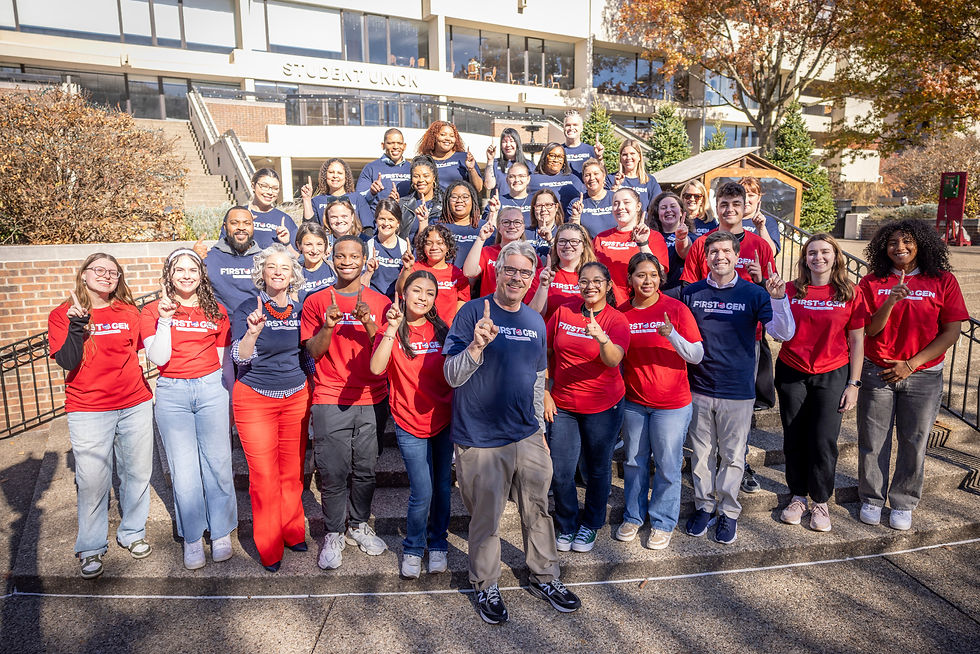
Roughly 30% of the student population at Duquesne is identified as first-generation. “Duquesne supports first-generation students and their families through a coordinated, cross-campus approach led by our First-generation College Student Retention Committee, which aligns communication and programming while assessing existing supports across the university and making strategic recommendations,” she said. Duquesne has several support systems developed by this committee, including first-generation sessions embedded in onboarding, transitional programming, and orientation for both students and families, and the newly chartered Alpha Alpha Alpha (TriAlpha) First-generation Honor Society. “We also intentionally build community through our parent and family portal and are currently developing a centralized first-generation resource dashboard on our website to make information easier to navigate,” she said.
Additionally, Duquesne is committed as a FirstGen Forward Network member, a national scaling model that brings together higher education leaders from around the country to share data, model innovation, and scale impact to first-generation student support. “We look forward to hopefully advancing our participation in the FGF Network in the coming year to becoming a network leader,” Kane said.
Like all college students, it is important — perhaps even more important — for first-generation college students to celebrate their successes. “For the past seven years, Duquesne University has intentionally celebrated the successes of our first-generation college students through National First-Generation College Student Day, held each year. This national day of recognition commemorates the signing of the Higher Education Act of 1965, which significantly expanded access to higher education. Building on this tradition, Duquesne will expand the celebration into a full First-Generation Celebration Week this coming year,” Kane said. “In addition, we are excited to introduce our newly chartered Alpha Alpha Alpha (TriAlpha) first-generation honor society this fall, with plans to induct our inaugural class of students by December. Together, these initiatives honor the achievements, resilience, and contributions of our first-generation students in meaningful and visible ways.”


I hope to see more on this particular angle, because you handled it beautifully. The writing strikes a lovely balance between informative and enjoyable to read. Each idea builds naturally on the last, so the whole thing flows smoothly. The real-world examples ground the theory and make it stick. This has earned a permanent spot in my reading list. Wonderful work.
This piece made me want to read article after article from you. The writing has a momentum that keeps you going past where you expected to stop. You connected the ideas in a clear, logical way. Nothing felt rushed or padded. It left me curious to explore the rest of the blog. Thank you for the engaging content. I'll be back soon.